

Thank you for Subscribing to Utilities Business Review Weekly Brief


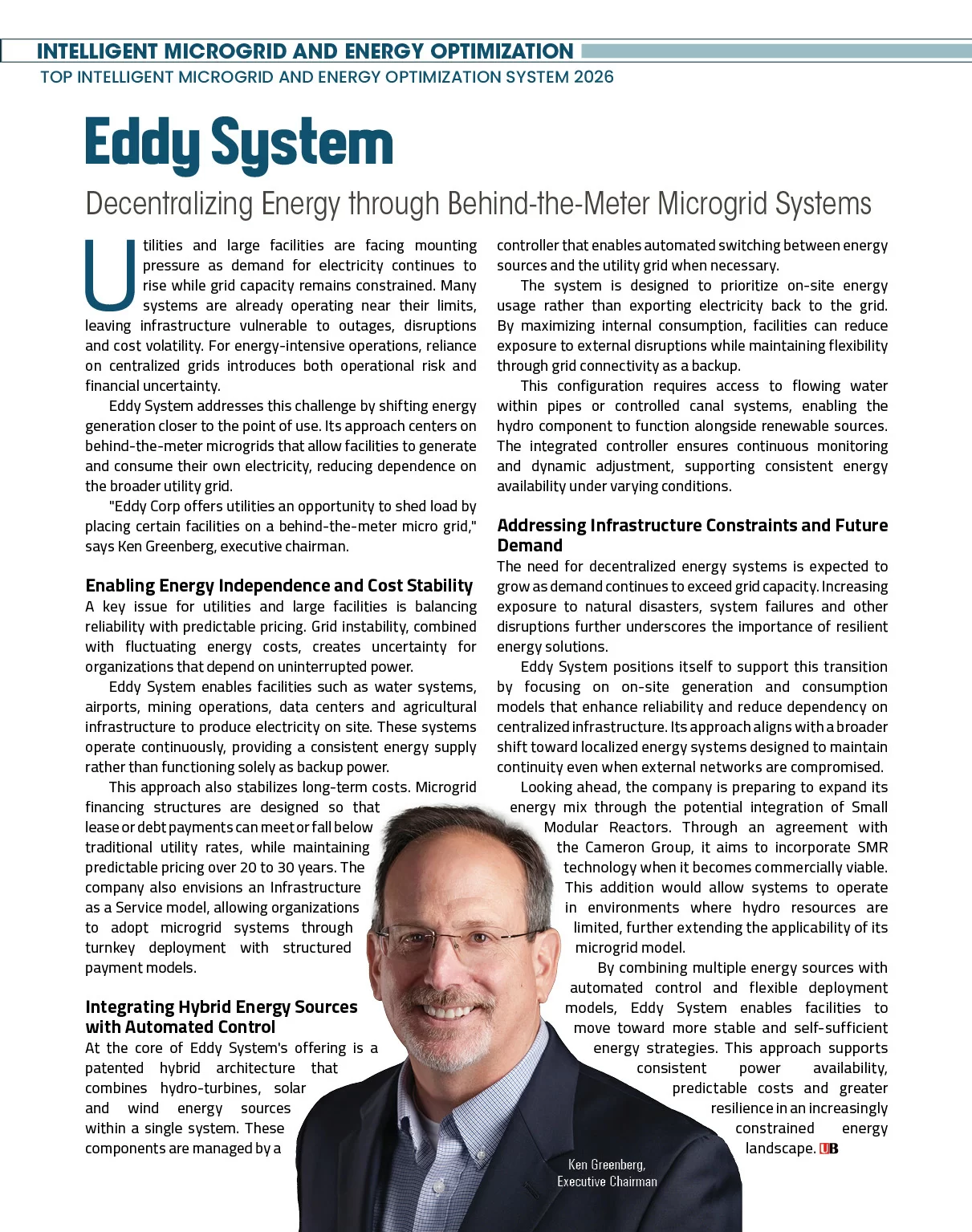
 Ken Greenberg, Executive Chairman
Utilities and large facilities are facing mounting pressure as demand for electricity continues to rise while grid capacity remains constrained. Many systems are already operating near their limits, leaving infrastructure vulnerable to outages, disruptions and cost volatility. For energy-intensive operations, reliance on centralized grids introduces both operational risk and financial uncertainty.
Eddy System addresses this challenge by shifting energy generation closer to the point of use. Its approach centers on behind-the-meter microgrids that allow facilities to generate and consume their own electricity, reducing dependence on the broader utility grid.
"Eddy Corp offers utilities an opportunity to shed load by placing certain facilities on a behind-the-meter micro grid," says Ken Greenberg, executive chairman.
Enabling Energy Independence and Cost Stability
A key issue for utilities and large facilities is balancing reliability with predictable pricing. Grid instability, combined with fluctuating energy costs, creates uncertainty for organizations that depend on uninterrupted power.
Eddy System enables facilities such as water systems, airports, mining operations, data centers and agricultural infrastructure to produce electricity on site. These systems operate continuously, providing a consistent energy supply rather than functioning solely as backup power.
This approach also stabilizes long-term costs. Microgrid financing structures are designed so that lease or debt payments can meet or fall below traditional utility rates, while maintaining predictable pricing over 20 to 30 years. The company also envisions an Infrastructure as a Service model, allowing organizations to adopt microgrid systems through turnkey deployment with structured payment models.
Integrating Hybrid Energy Sources with Automated Control
At the core of Eddy System's offering is a patented hybrid architecture that combines hydro-turbines, solar and wind energy sources within a single system. These components are managed by a controller that enables automated switching between energy sources and the utility grid when necessary.
The system is designed to prioritize on-site energy usage rather than exporting electricity back to the grid. By maximizing internal consumption, facilities can reduce exposure to external disruptions while maintaining flexibility through grid connectivity as a backup.
This configuration requires access to flowing water within pipes or controlled canal systems, enabling the hydro component to function alongside renewable sources. The integrated controller ensures continuous monitoring and dynamic adjustment, supporting consistent energy availability under varying conditions.
Addressing Infrastructure Constraints and Future Demand
The need for decentralized energy systems is expected to grow as demand continues to exceed grid capacity. Increasing exposure to natural disasters, system failures and other disruptions further underscores the importance of resilient energy solutions.
-
Eddy Corp offers utilities an opportunity to shed load by placing certain facilities on a behind-the-meter microgrid.
Eddy System positions itself to support this transition by focusing on on-site generation and consumption models that enhance reliability and reduce dependency on centralized infrastructure. Its approach aligns with a broader shift toward localized energy systems designed to maintain continuity even when external networks are compromised.
Looking ahead, the company is preparing to expand its energy mix through the potential integration of Small Modular Reactors. Through an agreement with the Cameron Group, it aims to incorporate SMR technology when it becomes commercially viable. This addition would allow systems to operate in environments where hydro resources are limited, further extending the applicability of its microgrid model.
By combining multiple energy sources with automated control and flexible deployment models, Eddy System enables facilities to move toward more stable and self-sufficient energy strategies. This approach supports consistent power availability, predictable costs and greater resilience in an increasingly constrained energy landscape.
