

Thank you for Subscribing to Utilities Business Review Weekly Brief


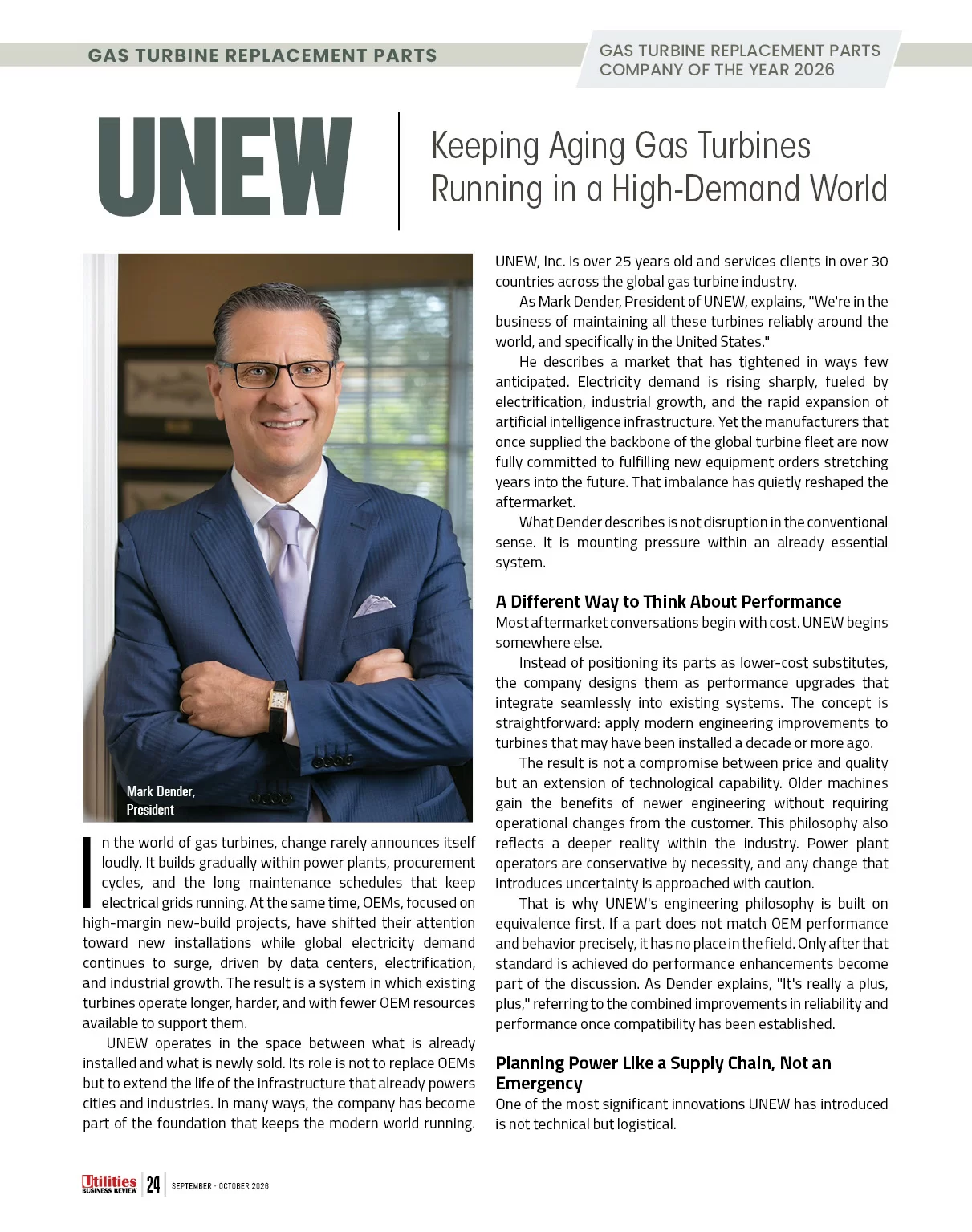
 Mark Dender, President
In the world of gas turbines, change rarely announces itself loudly. It builds gradually within power plants, procurement cycles, and the long maintenance schedules that keep electrical grids running. At the same time, OEMs, focused on high-margin new-build projects, have shifted their attention toward new installations while global electricity demand continues to surge, driven by data centers, electrification, and industrial growth. The result is a system in which existing turbines operate longer, harder, and with fewer OEM resources available to support them.
UNEW operates in the space between what is already installed and what is newly sold. Its role is not to replace OEMs but to extend the life of the infrastructure that already powers cities and industries. In many ways, the company has become part of the foundation that keeps the modern world running. UNEW, Inc. is over 25 years old and services clients in over 30 countries across the global gas turbine industry.
As Mark Dender, President of UNEW, explains, "We're in the business of maintaining all these turbines reliably around the world, and specifically in the United States."
He describes a market that has tightened in ways few anticipated. Electricity demand is rising sharply, fueled by electrification, industrial growth, and the rapid expansion of artificial intelligence infrastructure. Yet the manufacturers that once supplied the backbone of the global turbine fleet are now fully committed to fulfilling new equipment orders stretching years into the future. That imbalance has quietly reshaped the aftermarket.
What Dender describes is not disruption in the conventional sense. It is mounting pressure within an already essential system.
A Different Way to Think About Performance
Most aftermarket conversations begin with cost. UNEW begins somewhere else.
Instead of positioning its parts as lower-cost substitutes, the company designs them as performance upgrades that integrate seamlessly into existing systems. The concept is straightforward: apply modern engineering improvements to turbines that may have been installed a decade or more ago.
The result is not a compromise between price and quality but an extension of technological capability. Older machines gain the benefits of newer engineering without requiring operational changes from the customer. This philosophy also reflects a deeper reality within the industry. Power plant operators are conservative by necessity, and any change that introduces uncertainty is approached with caution.
That is why UNEW's engineering philosophy is built on equivalence first. If a part does not match OEM performance and behavior precisely, it has no place in the field. Only after that standard is achieved do performance enhancements become part of the discussion. As Dender explains, "It's really a plus, plus," referring to the combined improvements in reliability and performance once compatibility has been established.
Planning Power Like a Supply Chain, Not an Emergency
One of the most significant innovations UNEW has introduced is not technical but logistical.
Traditionally, turbine maintenance has been managed either through expensive long-term service agreements or reactive purchasing when outages occur. Both approaches involve risk. One locks operators into inflexible contracts, while the other exposes them to uncertainty and extended lead times.
UNEW has developed a middle path. Through a reservation-based system, customers can secure critical turbine components years in advance. A modest retainer reserves supply, while the final payment aligns with the actual timing of an outage. This approach enables operators to plan maintenance with significantly greater certainty without committing substantial capital upfront.
The model also reflects a broader reality in global manufacturing. Supply chains remain under pressure even after the disruptions of recent years. Lead times are longer, and production flexibility is more limited. For power operators, planning ahead is no longer optional—it is essential.
Where Service Becomes Partnership
UNEW's field presence extends well beyond supplying parts. The company works closely with maintenance providers responsible for managing large portfolios of turbines across multiple regions.
-
We're in the business of maintaining all these turbines reliably around the world and the United States specifically.
These organizations have become some of UNEW's most important customers, not because they own the turbines, but because they manage maintenance across entire fleets. They forecast component requirements, coordinate outages, and oversee execution across numerous sites.
By partnering with these organizations, UNEW moves beyond the role of a transactional supplier to become a strategic planning partner. Maintenance providers can develop their inventory strategies around UNEW's reservation model, transforming uncertainty into structured demand. The impact is subtle yet significant. Rather than reacting to failures, the maintenance ecosystem begins to anticipate them.
The Human Side of Engineering Depth
Behind the company's systems and strategies is a workforce deeply rooted in OEM experience. Many of UNEW's engineers previously worked for major turbine manufacturers such as GE, Siemens, and Pratt & Whitney.
That experience matters. It shapes how engineering challenges are approached, how tolerances are established, and how rigor is applied throughout testing and validation.
The company does not seek to reinvent turbine engineering. Instead, it builds upon established engineering principles and extends them thoughtfully. This continuity is one of the reasons operators continue to trust aftermarket components in increasingly mission-critical applications. The expectation is not novelty but reliability that performs exactly as intended.
A Market That No Longer Has Spare Capacity
Globally, gas turbine manufacturers are operating at full capacity. New equipment orders extend years into the future, and production lines are dedicated to expansion projects rather than supporting existing fleets. That reality has created a structural opportunity for companies like UNEW. This is not a temporary supply shortage but a long-term rebalancing of priorities across the energy sector.
As electricity demand grows faster than new infrastructure can be deployed, attention naturally shifts toward maintaining the assets already in operation. In that environment, aftermarket providers are no longer secondary players—they are essential contributors to energy reliability.
Looking Ahead to the Next Cycle
UNEW is preparing for a future defined by continued growth. The company is expanding production across multiple turbine platforms while increasing its capacity to support a growing global installed base.
Growth, however, is not pursued for its own sake. It is directly tied to improving reliability within an energy system that becomes more demanding each year. Dender reflects on his own experience by noting, "I spent 15 years at Pratt & Whitney."
That background reflects a broader truth within the organization. Much of UNEW's strength comes from professionals who have spent years inside OEM environments and understand both the discipline and the limitations of turbine engineering. The company's objective is not to replace that legacy but to complement it within an energy system where electricity demand shows no signs of slowing.
A Stable Answer in an Unstable Moment
In an industry shaped by volatility in demand, supply chains, and technology cycles, UNEW's positioning is intentionally steady. It does not promise transformation. It promises continuity.
In a world where reliable power has become the limiting factor for everything from data centers to transportation systems, continuity has become one of the industry's most valuable outcomes.
A quiet discipline underpins that approach. UNEW does not rely on dramatic reinvention or shifting market narratives. Instead, it builds consistency through disciplined processes, rigorous validation, and long-term planning. In a sector where downtime carries immediate financial and operational consequences, that steadiness becomes a competitive advantage. It is this underlying rhythm of predictability that enables operators to view maintenance not as disruption but as a managed lifecycle that supports long-term grid reliability, operational resilience, and sustained industrial growth.
Keeping Gas Turbine Outages on Schedule
A turbine outage cannot wait for a supplier backlog to clear. Power producers are carrying heavier load expectations while new gas turbine availability remains tight, and the maintenance market is absorbing the pressure that follows. The practical risk is not only part price. It is a missed outage window, a forced extension or a maintenance plan built around parts that may not arrive when crews and plant schedules are already committed. That exposure has become a board-level cost issue for generators trying to protect dispatch reliability.
Replacement parts decisions now sit between two expensive extremes. Long service agreements can secure access but may tie a plant to broad commitments and premium pricing. Waiting until failure or near-term outage planning leaves procurement exposed to long production cycles. The better purchasing question is narrower and more useful. Can the supplier match the required part form and service interval while giving the plant enough advance certainty to protect its outage calendar?
Engineering equivalence carries special weight in gas turbine maintenance because plant teams are conservative for good reason. A lower-cost replacement has little appeal if it changes inspection routines or maintenance intervals. Buyers should press for drop-in fit, documented parity with the original part and a clear explanation of any upgrade. The most credible aftermarket path often starts with exact replacement behavior, and then moves toward longer life, heat-rate gains, output improvement or better wear behavior only after technical confidence is established.
Planning discipline matters as much as metallurgy. The strongest suppliers are not merely quoting parts. They help customers reserve critical hardware years ahead without forcing them into a full-plant service wrap. That middle position gives owners and independent maintenance providers a way to protect outage timing while keeping control over project scope, cash flow, service partners and procurement timing. It also suits a market where repair firms may need inventory ahead of named projects because their regional workload already tells them what will be consumed.
Manufacturing depth should be tested model by model, not accepted as a broad claim. Legacy fleets, 50 hertz and 60 hertz machines, mature combustion systems and upgraded hot gas path configurations do not create the same parts burden. Buyers need to know where a supplier has repeat production, where it has current engineering coverage and where it is still building depth. Global reach also matters when the same scarcity affects plants across regions, although reach without schedule credibility does little for an outage manager.
UNEW fits this buying logic because it focuses on alternative combustion and gas turbine replacement parts backed by engineering work rather than simple resale. Its scope includes replacement parts and gas turbine engineering for electricity-generating plants, with inspection support tied to turbine manufacturing supply chains. The more important distinction is its planning model. By reserving parts well ahead of outage dates, it gives operators and maintenance firms a practical route between costly long-term OEM agreements and risky last-minute sourcing. For buyers that need schedule certainty without surrendering control of the whole maintenance program, UNEW is a restrained but clear choice.
...Read more
Gas Turbine Replacement Parts Companies Info
Q1
What Distinguishes Leading Gas Turbine Replacement Parts Companies?
Leading Gas Turbine Replacement Parts Companies combine engineering expertise, manufacturing quality and technical support to help extend turbine life while maintaining reliable performance. The strongest suppliers do more than manufacture replacement components. They improve legacy designs, strengthen reliability programs and produce parts that perform under demanding operating conditions. Many also invest in advanced manufacturing, inspection and quality control to deliver consistent gas turbine parts across critical industrial and aerospace applications.
Q2
How Does UNEW Stand Out Among Gas Turbine Replacement Parts Companies?
UNEW has built its reputation by re-engineering and manufacturing aftermarket gas turbine components for industrial and aerospace applications. Rather than simply replicating existing gas turbine parts, it focuses on improving legacy component designs through its gas turbine engineering expertise. The company also applies Statistical Process Control, digital manufacturing analysis and advanced inspection methods to identify process variation and maintain consistent product quality, strengthening its position among Gas Turbine Replacement Parts Companies.
Q3
What Capabilities Should Customers Look for in Gas Turbine Replacement Parts Companies?
When evaluating Gas Turbine Replacement Parts Companies, buyers should look beyond product availability. Engineering depth, manufacturing expertise, quality assurance, dimensional inspection and support for aging turbine fleets all matter. Experience with reverse engineering, process improvement and component redesign becomes especially valuable when original gas turbine parts are difficult to source or no longer available. Ongoing technical support also helps maintain dependable equipment performance throughout the service life.
Q4
Why Are High-Quality Replacement Parts Important for Gas Turbine Performance?
Reliable replacement components are essential for maintaining gas turbine efficiency, availability and service life. Gas Turbine Replacement Parts Companies help reduce maintenance risks by manufacturing gas turbine parts to precise specifications while incorporating improvements that address wear, durability or production limitations. Well-designed aftermarket gas turbine components can improve long-term equipment reliability and reduce the likelihood of unexpected downtime during operation.
Q5
How Does UNEW Support Long-Term Turbine Reliability?
UNEW helps ensure long-term reliability by bringing together skilled engineering teams and advanced manufacturing and inspection tools. Its engineers improve and redesign parts instead of just making copies. Digital process monitoring and Statistical Process Control keep manufacturing consistent. Automated inspections and modern production methods also raise the quality of aftermarket gas turbine parts, showing the extra value Gas Turbine Replacement Parts Companies can offer.
Q6
How Are Gas Turbine Replacement Parts Companies Evolving to Meet Industry Needs?
Modern Gas Turbine Replacement Parts Companies increasingly focus on engineering improvements rather than conventional replacement manufacturing. Better materials, advanced inspection methods, digital quality control and stronger gas turbine engineering practices allow suppliers to support aging equipment with greater consistency. As operators look to extend turbine life and improve maintenance planning, manufacturers that combine engineering, production expertise and technical support are better equipped to meet those expectations.
