

Thank you for Subscribing to Utilities Business Review Weekly Brief


What challenges do engineers face in assessing seepage behavior in water-retention structures?
All water-retention structures exhibit seepage as a function of hydraulic loading, material permeability, and foundation conditions. From an engineering standpoint, the governing question is not whether seepage is present, but whether subsurface flow behavior remains consistent with design assumptions and within defined safety thresholds. Effective risk management therefore depends on resolving seepage origin, connectivity and migration pathways with sufficient confidence to support operational and mitigation decisions.
Willowstick provides high-resolution, non-invasive seepage intelligence for dams, levees and tailings storage facilities by directly characterizing subsurface flow behavior rather than inferring conditions from surface indicators alone. While most structures are designed to tolerate controlled seepage through drains, filters and foundations, uncertainty increases as assets age, hydraulic regimes change or subsurface conditions deviate from original design assumptions. Willowstick reduces this uncertainty by mapping active flow paths within the embankment, abutments and foundation materials.
Across the 62,000+ global large dam inventory, a measurable percentage of large structures are rated in unsatisfactory condition with high risk of major loss of life and economic damage and recent failures, including tailings facilities, have underscored the consequences of unresolved seepage mechanisms. For owners and engineers, the critical input is whether seepage behavior is stable, progressive or trending toward defined performance or safety limits, even when surface conditions appear unchanged. Willowstick supports this assessment by resolving subsurface dynamics that are otherwise unobservable using conventional monitoring alone.
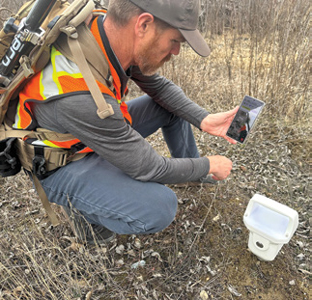 Traditional instrumentation, such as piezometers, seepage weirs and visual inspections, can confirm the presence and magnitude of seepage, but often provides limited insight into flow-path geometry, hydraulic connectivity or causality. This can force decision-makers into either conservative, high-cost mitigation or continued monitoring with unresolved risk. Willowstick fills this gap by supplying spatially resolved, model-based interpretation of seepage pathways that directly informs engineering judgment.
“Willowstick identifies seepage paths with high accuracy, helping owners manage seepage within defined safety thresholds and focus mitigation where it matters most,” says Scott Osterman, president and CEO.
Resolution as the Primary Driver of Engineering Confidence
How does Willowstick’s multi-method diagnostic framework improve seepage interpretation and engineering confidence?
Willowstick’s technical advantage lies in its integrated, multi-method diagnostic framework, designed to reduce ambiguity in seepage interpretation. The objective is not anomaly detection in isolation, but confident attribution of observed data to model water driven flow behavior that is relevant to structural performance and safety.
At the core of the system is a patented electromagnetic method that measures localized anomalies in current density. Because actively flowing water alters electromagnetic response relative to static or bound water, these measurements can be used to infer preferential seepage pathways. The interpretation explicitly filters out non-hydraulic electromagnetic sources, such as metallic infrastructure, utilities and external interference, ensuring that modeled results remain focused on true seepage behavior.
This electromagnetic dataset is integrated with supporting diagnostics, including photogrammetry, satellite imagery and, where appropriate, patented microseismic resonance data collection. All inputs are evaluated within a single modeled framework, allowing cross-validation of suspected flow paths against structural geometry and subsurface features. This contrasts with single-modality approaches, which may identify anomalies without resolving whether they are hydraulically meaningful.
-
Willowstick identifies seepage paths with high accuracy, helping owners manage seepage within defined safety thresholds and focus mitigation where it matters most.
Resolution is a defining operational outcome. While many seepage detection methods can localize concern to broad zones, Willowstick can resolve the centrality of a seepage pathway within a narrow spatial range. In practice, this level of resolution materially improves decision-making by allowing engineers to distinguish between diffuse seepage compatible with design intent and concentrated flow paths that may warrant intervention.
Measurement Density and Subsurface Modeling
Why are measurement density and integrated subsurface modeling essential for accurate seepage analysis?
To support defensible interpretation, Willowstick emphasizes measurement density and redundancy. Field campaigns may include drone-based electromagnetic measurements, supplemented by ground surveys where site conditions require higher spatial control. These measurements are compiled into a point cloud and integrated into a three-dimensional model that depicts seepage pathways relative to the structure, foundation and abutments.
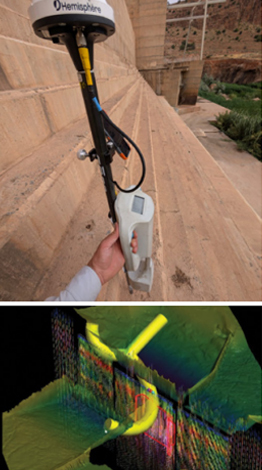 In complex geological settings, microseismic diagnostics provide additional subsurface context by identifying fractures, high-porosity zones or material contrasts that influence hydraulic connectivity. This capability is particularly valuable where seepage emerges at locations disconnected from entry points, or where flow paths are controlled by foundation conditions rather than embankment materials.
For owners, engineers and independent reviewers, the resulting model supports clearer articulation of seepage mechanisms, more defensible safety threshold definition and improved alignment between observed behavior and engineering expectations.
Decision-Making and Safety Outcomes
In what ways does resolving seepage pathways improve safety decisions and mitigation strategies?
By resolving the origin, connectivity and migration of seepage, Willowstick enables high-consequence decision-making in various critical areas. It helps differentiate between benign and actionable seepage, ensuring that unnecessary interventions are minimized while allowing for early identification of emerging risks. Willowstick also enables the targeted application of mitigation measures, such as grouting, drainage modification or cutoff improvements, at locations where they can most effectively reduce risk.
In addition, it enhances safety margin assessments, particularly when seepage behavior evolves but surface indicators lag behind subsurface changes. Moreover, the technology supports regulatory and independent reviews by providing defensible, spatially resolved evidence of subsurface conditions. This transforms seepage detection from a qualitative observation into a quantitative, actionable engineering input, strengthening both operational decision-making and long-term asset safety.
Scalable Delivery Across Complex Assets
Willowstick has delivered projects globally across a wide range of dam types, foundation conditions and operating environments, including tunnels. While site conditions vary, the fundamental challenge remains consistent, resolving subsurface water behavior with enough confidence to guide proportionate, timely decisions.
Delivery is scaled through partnerships with engineering firms and facility owners, supported by a direct or service-affiliate model for field execution. Willowstick retains responsibility for data integration, modeling, interpretation and reporting standards, ensuring consistency and technical rigor across sites.
United States based Willowstick Technologies LLC, a Guardian Resources company is the global leader in subsurface geophysical technology, investigations and mapping for the mining, environmental, agricultural, construction, real estate development and water management and energy production industries for the protection, preservation and discovery of the world’s most valuable resource, water.
Finding the Right Partner for Dam Leak Detection
Water-retaining assets rarely fail because a visible leak was misunderstood. The greater risk usually sits in the unseen path between stored water, embankment materials, foundations, adjoining structures and downstream receptors. For executives responsible for dams, reservoirs, canals, levees or tailings storage facilities, leak detection has become less a narrow inspection task than a decision point that affects water stewardship, public safety, environmental exposure, regulatory confidence and capital planning.
The practical challenge is that seepage is not automatically a defect. Many structures are designed to allow controlled movement of water, and owners must distinguish acceptable seepage from flow patterns that suggest deterioration, internal erosion or developing instability. Surface evidence can be misleading. Water may exit far from its entry point, divide through several pathways, converge through hidden structures or be influenced by fractures, porous zones, utilities or nearby infrastructure. A useful service must therefore move beyond confirming that water is present. It should help management teams understand where the flow begins, how it travels and what action would reduce risk without unnecessary intervention.
Precision matters because remediation budgets are often shaped by uncertainty. Broad indications can push owners toward oversized grouting, repeated exploratory work or extended monitoring when a focused repair would have been more appropriate. The strongest approach provides enough spatial resolution to support engineering judgment, not simply enough evidence to justify further investigation. Decision-makers should expect subsurface mapping that links field measurements to a clear interpretation of flow paths, depths, likely entry zones and downstream expressions. The output must be intelligible to executives, engineers and regulators because the same findings may guide funding, emergency planning, maintenance sequencing and stakeholder communication.
Non-intrusive investigation is also central in this field. Dams and water-retaining structures cannot be treated like ordinary assets that can be disrupted at will for inspection. Methods that reduce disturbance while collecting dense data across the reservoir side, the embankment, the face and downstream areas give owners a better chance of understanding the asset without increasing exposure. The work should adapt to terrain, scale and access constraints through field crews, remote capture where needed and integration of complementary geophysical techniques. A service provider’s value is strongest when it can separate water-related signals from surrounding interference and translate large volumes of measurement data into a usable three-dimensional view.
Executives should also weigh whether a partner can support both confirmation and discovery. Some engagements require locating a suspected leak. Others require evidence that a concerning structure does not show material seepage at the time of review. In both cases, the outcome should improve confidence in what to monitor, where to intervene and how to preserve the asset's value.
Willowstick stands out for organizations that need targeted dam, reservoir and canal leak detection grounded in subsurface flow mapping rather than surface observation alone. Its relevant services combine patented geophysical and hydro-physical methods, field data capture and three-dimensional modeling to identify seepage pathways and support remediation planning. Its field approach can also include satellite diagnostics, photogrammetry, drone capture, electromagnetic flow-path analysis and passive microseismic assessment when conditions warrant. For owners facing uncertainty about hidden seepage routes, Willowstick is a disciplined choice because it focuses on locating and explaining the water pathway before committing capital to repair.
...Read more
Dam Leak Detection Services Info
Q1
What Should Owners Expect from Dam Leak Detection Services?
A useful investigation should explain where seepage begins, how it moves and whether it points to a maintenance issue or a potential safety concern. Dam Leak Detection Services should do more than confirm the presence of water. Owners need enough spatial detail to determine whether to monitor, repair, drain, grout or investigate further. Poor interpretation early in the process can turn a manageable leak into repeated field work and unnecessary costs. The strongest reports connect field findings to practical next steps instead of leaving teams with another uncertain inspection record.
Q2
How Does Willowstick Technologies Strengthen Subsurface Seepage Analysis?
Willowstick Technologies focuses on high-resolution, non-invasive seepage intelligence for dams, levees and tailings storage facilities. It characterizes subsurface flow, maps active pathways through embankments, abutments and foundation materials and reduces reliance on surface indicators alone. In Dam Leak Detection Services, this matters because visible wet spots rarely tell owners whether flow is stable, expanding or linked to a deeper foundation pathway. That distinction can influence how teams set thresholds, schedule follow-up activities and select repair locations.
Q3
Why Is Three-Dimensional Modeling Useful Before Repair Work?
Repair plans are more effective when engineers can identify the likely path of water rather than focusing only on the point where it exits. Dam Leak Detection Services often use three-dimensional models to connect field measurements with depth, direction and structural context. This perspective can help prevent overly broad grouting, unnecessary drilling or repairs that fail to address the actual pathway. It also gives technical teams a stronger foundation for explaining decisions to owners and reviewers. Most structures can tolerate some seepage, which makes context just as important as detection.
Q4
Which Signals Matter When Seepage Looks Unclear?
Seepage volume is only one part of the assessment. Entry zones, connectivity, path depth, exit locations and surrounding interference can all change the meaning of the same wet area. Dam Leak Detection Services should distinguish water-related signals from metallic infrastructure, utilities, fractures or porous materials that may affect readings. The real value comes from understanding whether the flow pattern is expected, changing or concentrated enough to require action. Without that distinction, teams may end up spending money on symptoms rather than causes.
Q5
What Makes Willowstick Technologies Relevant for Complex Water-Retention Assets?
Willowstick Technologies combines patented electromagnetic methods, satellite diagnostics, photogrammetry, drone capture and passive microseismic assessment when conditions require deeper analysis. It also uses field data, point-cloud integration and three-dimensional modeling to describe seepage pathways in relation to the structure, foundation and abutments. For Dam Leak Detection Services, this combination helps engineers determine whether a suspected pathway is driven by water rather than influenced by metal, utilities or geological features. The approach is especially valuable when entry and exit points do not align clearly.
Q6
How Should Decision-Makers Compare Providers?
Ask providers to demonstrate how their findings will influence monitoring, maintenance or remediation decisions rather than focusing only on how a leak is detected. Dam Leak Detection Services should produce clear reports that support engineering reviews, budget planning and discussions with regulators. A practical way to evaluate a provider is to ask how it would handle a leak that surfaces far from its point of entry or splits into several hidden pathways. Strong providers can explain uncertainty, clarify their assumptions and make the next engineering decision easier to manage.
