Thank you for Subscribing to Utilities Business Review Weekly Brief
Utilities Business Review: Specials Magazine

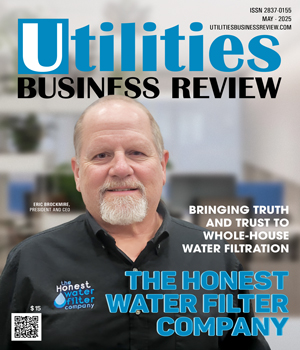
While over 90 percent of the U.S. population relies on public water systems regulated under the Safe Drinking Water Act, the reality tells a more nuanced story. Residual disinfectants—normally chlorine-based—along with trace levels of heavy metals and chemical byproducts in tap water—have raised valid concerns about long-term water quality. This growing skepticism has led many households to seek alternatives, including bottled water and in-home filtration systems. The Honest Water Filter Company (HWF) is stepping in to address that shift with transparency and integrity. HWF initially developed commercial-grade filtration systems to meet the rigorous demands of the food service industry. Now, it is refining them for residential use, offering homeowners a durable, high-performance solution backed by industry standards. “Water is the closest thing we have to an elixir of life—essential for health, comfort, and peace of mind. Protecting its purity demands a commitment to truth and performance and we take that responsibility seriously,” says Eric Brockmire, President and CEO. Every HWF filter is certified for performance by the National Sanitation Foundation (NSF), the gold standard for water filtration testing. Product claims can be verified publicly, offering homeowners transparency and confidence in what’s flowing from their taps. “That matters more than most realize,” adds John Phipps, VP of marketing. “Many systems claim to remove chlorine, yet they rarely pursue performance certifications that offer peace of mind not only to the homeowner but also to the company providing and installing the product. We’re focused on delivering certified protection—not assumptions.” As more Americans question what’s in their water, HWF answers them with science, certification, and a commitment to clean water without compromise. Engineered for What Matters—Performance, Purity and Protection Not all filters are built the same and HWF doesn’t aim for average. Its cartridge-based filtration systems trap and hold contaminants rather than flushing them through the system. The standard configuration filters particles down to 5 microns, effectively addressing point-of-entry (POE). Additional protection can be found in their point-of-use (POU) product, which filters contaminants down to 0.2 microns, which can consist of microplastics and cysts. This offers protection that most suppliers can’t match.
Top Utility Consulting Service 2025
Subterranean Consulting Group
Beneath the Surface: Redefining the Utility Space
Adam Zeciri, Founder
Beneath every street and cityscape lies an invisible network of strategic lifelines in the form of waterlines, sewage lines, gas pipelines and electric cables. Maintaining, mapping and securing this underground web of networks demands specialized knowledge and expertise that can only be brought in by an experienced hand. Founded by renowned utility locating and mapping expert Adam Zeciri, Subterranean Consulting Group navigates this underground maze with precision and clarity. It offers a holistic ecosystem that integrates consulting, training, field services and operator qualifications. This end-to-end utility solutions provider caters to the renewable energy sector, oil and gas, water, sewer and communication markets, providing services from production and transmission to distribution. “Our approach is built on transparency and collaboration. We prioritize understanding our clients’ challenges, guiding them to the best solutions and delivering the outcomes they need,” says Zeciri. Subterranean operates through two key divisions to achieve this: Sub-T and Locating Dynamics. Sub-T encompasses field services, compliance services, operator qualifications, underground utility locating and data collection for all types of subsurface utility infrastructure. On the other hand, Locating Dynamics focuses on providing different avenues of locator training, offering online and in-person best-in-industry training for the workforce. The courses are curated and vetted by world-class utility locating and mapping technology experts. This covers electromagnetic (EM), ground penetrating radar (GPR), acoustic pipe locator (APL), SPAR utility surveying and real-time kinematic (RTK) utility mapping. Together, these two divisions allow Subterranean to address some of the most pressing challenges in the field, whether it’s a lack of trained professionals or hazy standard operating procedures. Training modules catering to all skill levels present information in manageable chunks while enabling knowledge retention. Courses are designed to maximize learning outcomes and ensure effective knowledge transfer. Its train-the-trainers program develops internal training capabilities, allowing the organizations to train and certify employees.

CXO INSIGHTS

Collaboration Across Multiple Sectors Can Speed the Transition to Electric Transportation
Dan Bowermaster, Sr. Program /Area Manager, Electric Transportation, EPRI

Strategic Initiatives for a Cleaner Energy Future
Ivon Louis-Letang, Energy Manager, Eversource Energy

The Evolution and Integration of Renewable Energy
Jim Helvig, P.E., Vice President Operations, Dashiell Corporation

Aligning Technology with Business Goals for Improved Efficiency
Raied Stanley, Vice President, Chief Information Officer, Southwest Gas Corporation

Pacing Along the Energy Evolution
Julian Kaufmann, Chief Commercial Officer, CAMS


IN FOCUS

EDITORIAL
The Future-Ready Utility: Adapting to Consumer Needs and Environmental Goals
The utility sector has witnessed major transformations and is considered one of the most stable and indispensable service providers. It has transformed from just domains that deliver elementary basic services such as water, electricity, and gas into an active, interconnected network driving sustainability, resilience, and innovation. Digitization, renewables integration, and changing consumer needs are the key forces that lead to this transformation. Collectively, they are redefining the contemporary role of utilities and their operational and service delivery models in the face of an everchanging global landscape.
The growing demand for clean energy and efficient infrastructure prompts utility providers to revise their business models. They are implementing smart grids, advanced metering systems, and AI forecasting tools to enhance reliability and speed in service delivery. These advancements also allow for real-time responses to changes in consumption patterns and outages, contributing to the rapid growth of the global utilities market.
The global utility market is now projected to be valued at more than $6 trillion in 2024 and is still rising. It stems from increased demand for energy, urbanization, and significant investments in new infrastructure, fueling growth. In a world increasingly powered by clean energy, thanks to government initiatives and innovations by the private sector, what was once necessary has become a vision aligned with executive goals. This shift drives a commitment to ensuring utilities operate reliably without being noticed while visibly demonstrating their environmental capabilities.
Transformation is not merely technological; it’s cultural as well. Customers are no longer passive beneficiaries; they are participants. They want transparency, choice, and control over their energy consumption. Utilities offer personalized services such as time-ofuse pricing, energy usage dashboards, and green power options to encourage participation. Indeed, the paradigm is redefining the relationship between provider and user into one that is becoming more collegial than commercial.
The utility sector is transforming significantly due to digital innovation, clean energy alternatives, and customer-driven models, promoting sustainability, resilience, and improved collaboration between providers and consumers for a brighter future.
